20+Years spanning sales, residential design and construction
Read Beyond the Renovation
You Can See the Finish. What Can You Verify?
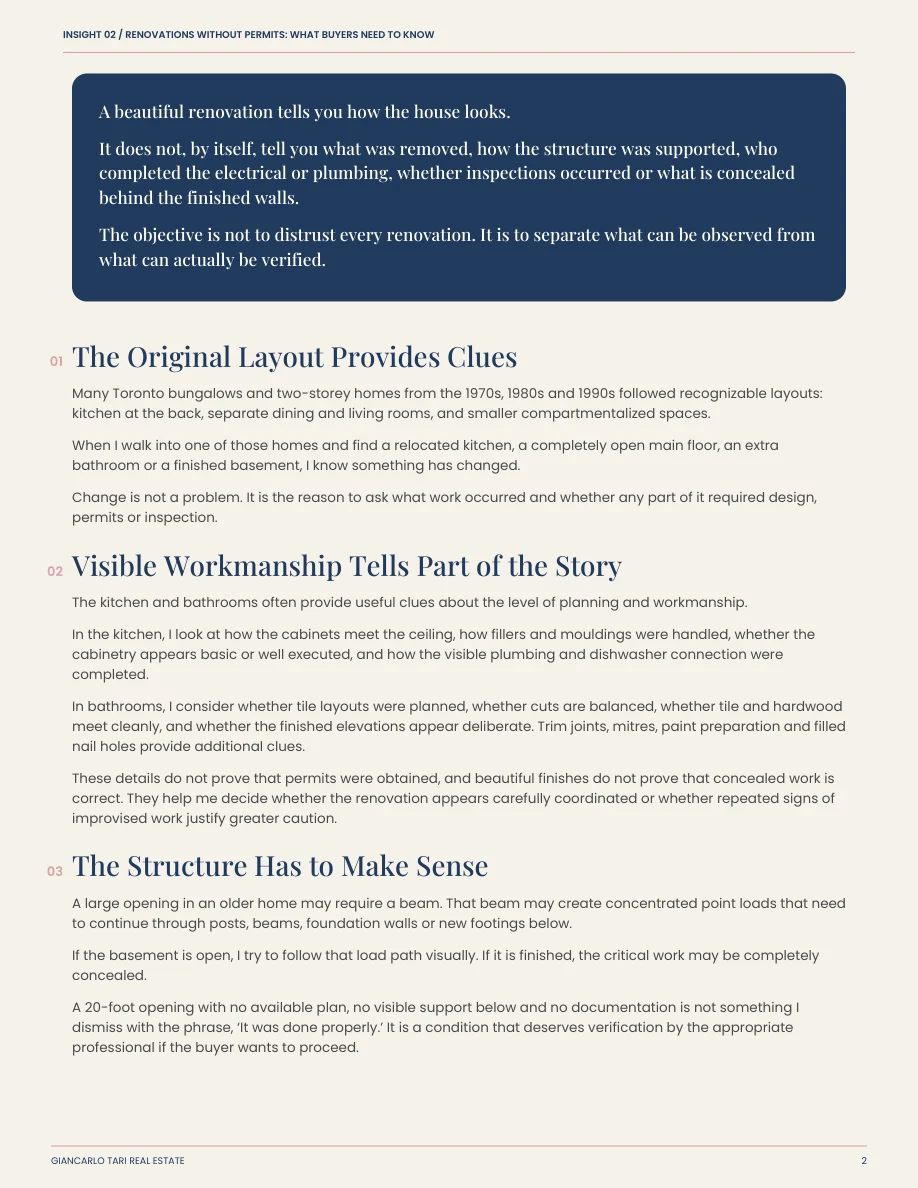
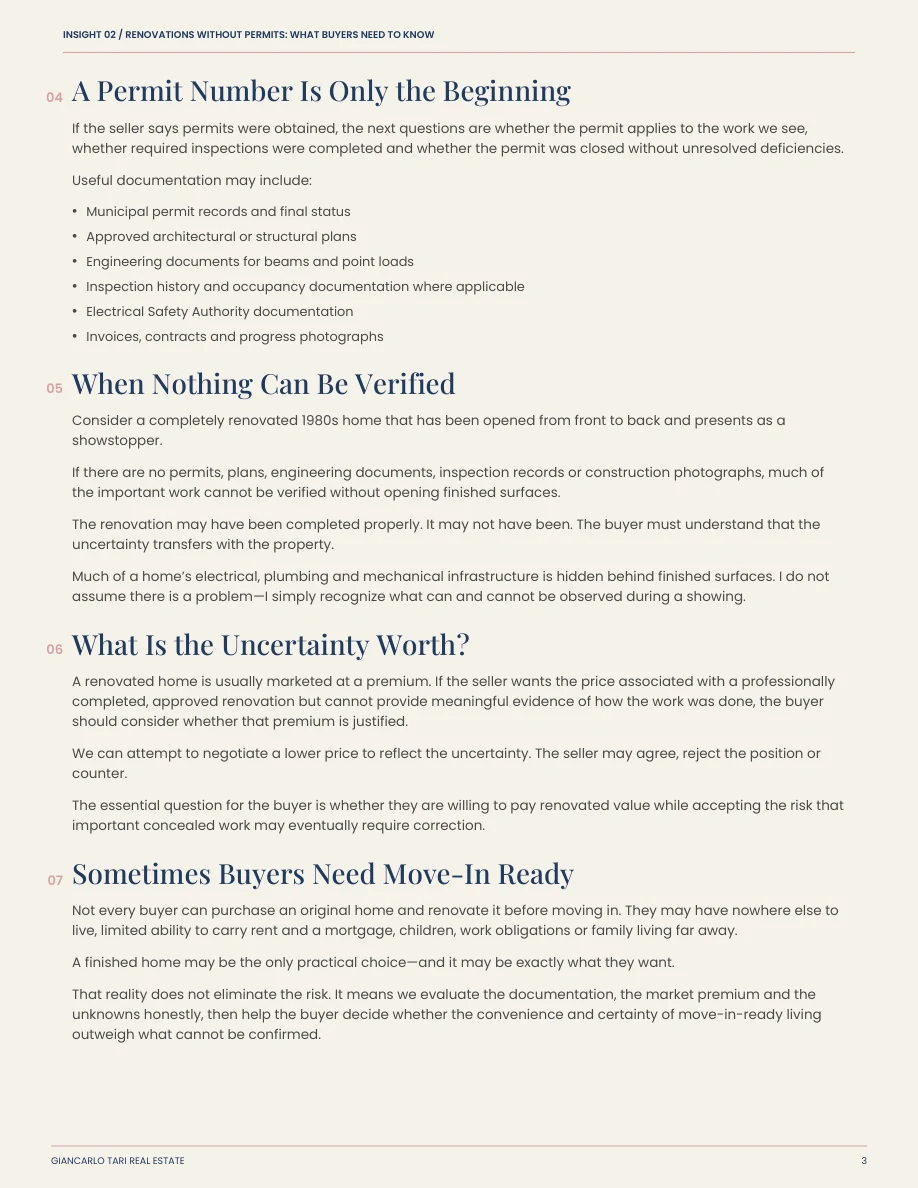
An open kitchen, fresh flooring and a beautifully finished basement can change how a home feels. They can also leave questions about what was removed, what supports the new layout and what is concealed behind the walls.
In this guide, I explain how I approach a renovated property: start with the original layout, notice the workmanship, ask for the relevant records and understand the uncertainty that remains. The goal is to make an informed decision about the house in front of you.
Separate what you can observe from what you can actually verify.
Read before you decide
Better questions. Better information.
A renovated home raises two separate questions: what changed, and what can be verified about that work? Use the records to understand scope before drawing a conclusion about the whole property.
01
Does the renovation need a building permit?
Ontario’s building-permit guidance explains the municipal approval process and notes that other approvals may also apply. Requirements depend on the work. Ask the building department about the specific alteration; photographs and a general description of a renovation are not a property-specific permit determination.
The Electrical Safety Authority states that a building permit is different from an electrical notification. Most electrical work requires notification to ESA, subject to exceptions. Check the original electrical scope and the applicable process directly with ESA.
ESA issues a Certificate of Acceptance after the notified electrical work has been reviewed and passed. Ask for the certificate and identify the work it relates to. Keep it alongside the renovation documents, rather than treating it as a general assessment of all construction in the house.
Giancarlo’s professional framework: make a list of the work described, the records located and the unresolved gaps. Ask the municipality or relevant authority what can be confirmed. Discuss the remaining uncertainty with your legal adviser and the appropriate specialist before deciding how to proceed; do not assume missing paperwork proves either safety or danger.
Giancarlo’s professional perspective
Giancarlo looks at the original layout and the visible workmanship to decide which questions to ask. The finish can guide attention, but it cannot certify the concealed work. The practical aim is to understand both the records and what they leave unanswered.
Original sources
Reviewed September 19, 2026. Follow the original source for updates and property-specific requirements.
A practical framework for reviewing the visible work, the supporting records and the questions that still need an answer.
01
The Original Layout
Consider how the home was originally arranged and which later changes may deserve an explanation.
02
Visible Workmanship
Look at the care in the details while recognizing the limits of what finished surfaces can show.
03
The Structural Story
Ask how larger openings and removed walls were supported, and what professional review accompanied the work.
04
The Permit Scope
Understand what a permit relates to instead of treating a permit number as the whole answer.
05
Inspection Records
Ask what inspections occurred and which records help explain the work that was completed.
06
Unverified Work
Identify what remains unknown when documentation is incomplete or unavailable.
07
The Cost of Uncertainty
Consider how unresolved questions could affect your budget, plans and comfort with the purchase.
08
Move-In-Ready Needs
Be honest about the time, money and disruption you can take on after moving in.
09
The Better Question
Bring the observations and evidence together before deciding whether the renovation makes sense for you.
A Look Inside
Visible Work. Supporting Records. A Clearer Decision.
The guide begins with the clues a renovated home can reveal, then moves into the documentation that helps explain what happened behind the finishes.
It also considers the buyer’s side of the decision: how much uncertainty you can accept, what further investigation could involve and whether the property fits your need for a move-in-ready home.
A permit number starts a conversation. The details help complete it.
A REALTOR® Who Has Worked With Homes From More Than One Perspective.
Long before real estate became his profession, Giancarlo was designing, permitting, building and renovating homes. Today, that experience shapes the questions he asks during a showing and the conditions he knows should be verified before a buyer becomes committed.
This perspective does not replace a home inspector, engineer or qualified specialist. It helps identify when one should become part of the conversation.
You do not need to know everything. You need to know what to verify.
Question. Clue. Verification.
Ask About the Work Behind the Finish.
Download Insight 02 and keep these renovation questions close before your next purchase decision.
Educational information only. This guide is general information and is not a home inspection, engineering report, appraisal, legal opinion, environmental assessment or substitute for advice from appropriately qualified professionals. Visible conditions are clues that may warrant further investigation and are not proof of a defect.